Description
For the processing of small products, such as flower bulbs, we produce webs with “twin rods”. A twin rod consists of 2 rods, which are clamped together at their ends, by a tube. The actual pitch is half of the belt pitch. wanneer er gebruik wordt gemaakt van bekleding om de staven kan er een doorval worden gerealiseerd tot minimaal 2mm. With the use of rod coverings we can create a gap as small as 2mm Twin rods are also standard constructed with spring steel rods, though stainless steel and glass fibre rods are also available.
Outer belt
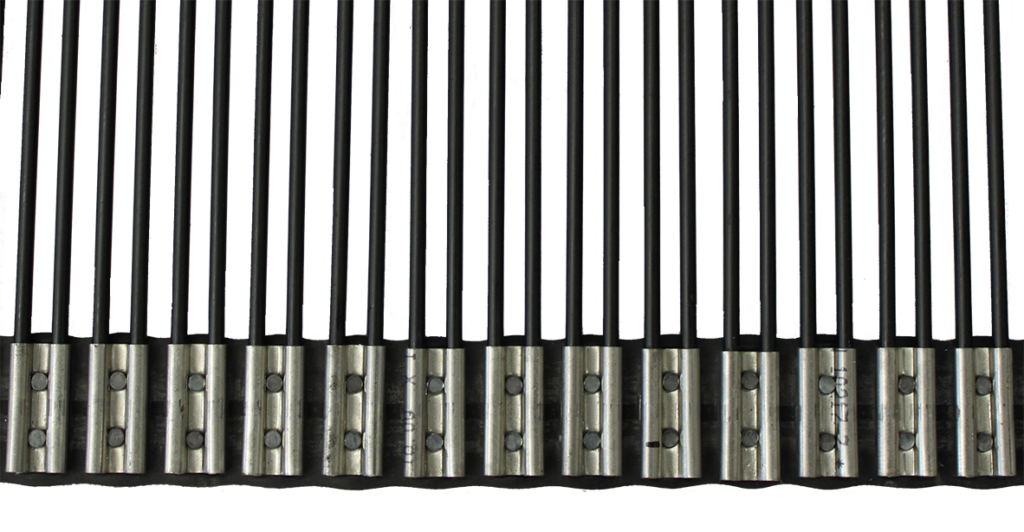
S-type belt with twin rods riveted onto it
Twin rod on center belt
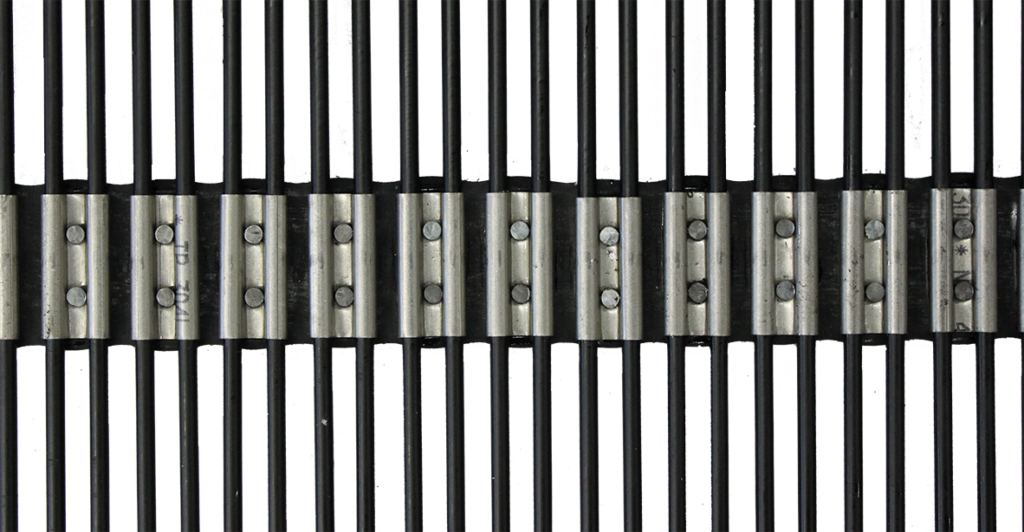
Center belt with twin rods riveted onto it
Centre reinforcement
In order to keep the gap between 2 rods consistent can be chosen for centre reinforcement. This is often used when the rods have a small diameter or the span between 2 belts is large.
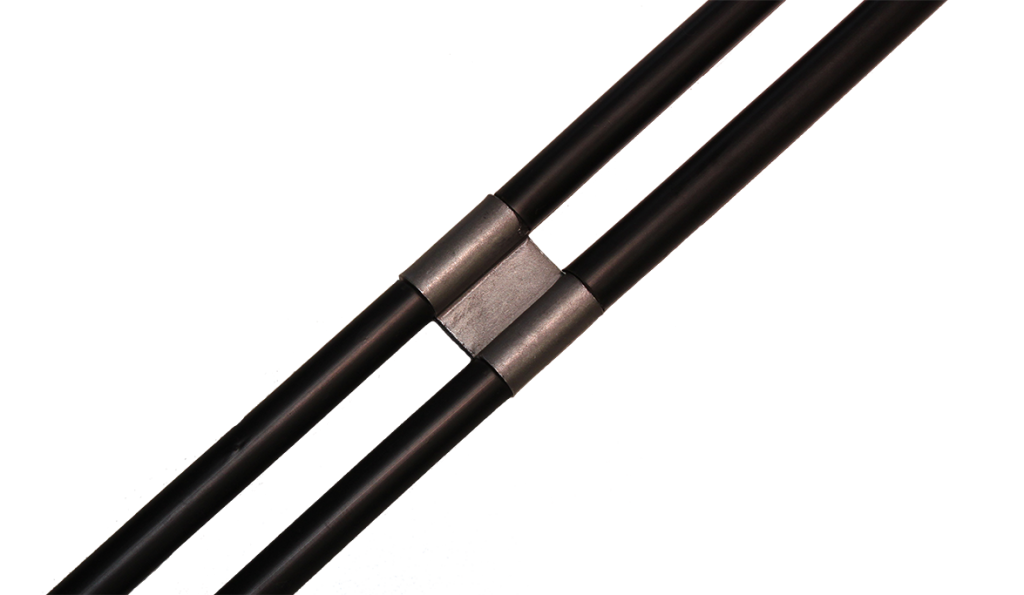
Rod-to-rod measurement (Stokmaat)

To determine the correct width of the sieve belt, it is essential that the twin rods have the accurate rod-to-rod measurement. This is the distance between the two outside rivet holes, C.T.C. When ordering individual twin rods, it is essential to provide the rod-to-rod measurement as well as the hole pitch at the ends of the twin rod. Unless otherwise specified, we assume this pitch to be 20 mm for 50 mm wide traction belts, and 32 mm for 60 mm or 75 mm wide traction belts. Deviations from these standards are available upon request. We can also provide hole pitches of 24 mm or 30 mm on request.
Material options
Spring steel
As standard, our twin rods are manufactured from spring steel, class C (DIN 17223/17228). However we can also make twin rods of CrSi-steel, stainless steel or glass fibre. After consultation with you, we can also use other materials so that the produced web will meet your expectations as good as possible.
CrSi
For applications in extremely demanding conditions, such as stone pickers, we manufacture the rods from extra-high-strength material. For this, we use chrome silicon steel (CrSi). CrSi steel is harder and tougher than class C spring steel. Furthermore, this steel possesses all the properties of ‘standard’ spring steel. CrSi steel is available in diameters of 8, 9, 10, 11, and 12 mm. A major advantage of CrSi steel is that it is highly suitable for welding.
RVS
For underwater applications, stainless steel (RVS) is widely used. In this configuration, all metal components of the sieve belt are executed in stainless steel. The rods and the fastening materials are then made of AISI 304 stainless steel. Upon request, the rods can also be manufactured from AISI 316 stainless steel. However, the fastening materials will remain in AISI 304 stainless steel.
Fiberglass
To reduce weight, fiberglass rods can sometimes be used. A sieve belt with fiberglass rods weighs up to approximately 50% less than a comparable sieve belt with steel rods. An additional advantage of these fiberglass rods is the fact that they do not rust. These rods are available in diameters of 6, 8, and 10 mm.